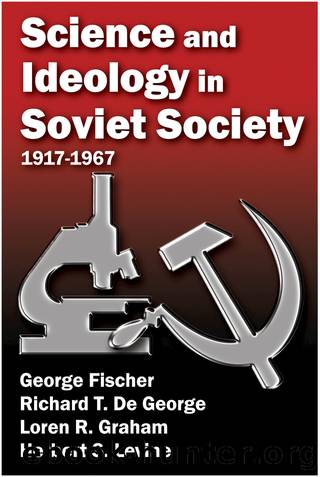
Science and Ideology in Soviet Society: 1917-1967 by George Fischer
Author:George Fischer [Fischer, George]
Language: eng
Format: epub
Tags: Political Science, General
ISBN: 9781351491983
Google: 0FUPEAAAQBAJ
Goodreads: 35865408
Publisher: Routledge
Published: 2012-03-01T00:00:00+00:00
Ideological Discussions
Cybernetics coincides with the materialism and optimism of Marxism, but it also raises a number of serious philosophical and sociological problems. Cybernetics is closely connected to a number of fieldsâsuch as psychology, econometrics, pedagogical theory, logic, physiology, and biologyâwhich were subjected to ideological restrictions in Stalin's last years. In the early 1950s Soviet ideologists were definitely hostile to cybernetics, although the total number of articles opposing the field unequivocally seems to have been no more than three or four.7 One author, writing in Literaturnaia gazeta in 1952, termed cybernetics a "science of obscurantists" and ridiculed the "mechanistic" view that computers can think or duplicate other functions of organic life. The militant critic accused the leaders of capitalist society of promoting the development of cybernetic mechanisms which would perform their society's unpleasant tasks for them: the striking and troublesome proletariat would be replaced by automatic machinery, bomber pilots who object to bombing helpless civilians would be replaced by "unthinking metallic monsters."8
Cybernetics seems to have found its first defender in the Soviet Union in Ernst Kolman, the Czech philosopher and mathematician. Professor Kolman, a long-term resident of Moscow, played a revealing role in disputes over the philosophy of science. Among Czech scientists he is generally known as a rigid ideologue but, perhaps not so paradoxically, in the Soviet Union he has often taken the more liberal side in various controversies. As long ago as 1938 he was praised by the eminent Soviet physicist V. A. Fock for his tolerant view of certain philosophic implications of relativity theory. In a recent issue of Voprosy filosofii Kolman pleaded that Soviet scientists be given permanent freedom to consider scientific theories which contradict common-sense notions.9 In 1954, Kolman gave a lecture on cybernetics to the Academy of Social Sciences of the Central Committee of the CPSU, which was very much in this tolerant tradition.10 Kolman emphasized his belief that cybernetics was causing a technological revolution which the Soviet Union had so far largely ignored. This revolution could be compared in significance, he said, to the implementation of the decimal numeral system or the invention of printing. Only later would the full irony of Kolman's assuming the role of champion of cybernetics emerge; in later years he was exceeded in his enthusiasm for the field by many Soviet scholars, and in a number of recent articles he has appealed for restraint in evaluating the applicability and potentiality of cybernetics.11
In the period from 1954 to 1958, Soviet scholars debated the legitimacy of cybernetics as a field of study. A number of them noted, quite correctly, that there were no accepted definitions of "cybernetics" or "information" even in the West; much of the discussion revolved around fruitless attempts to agree on terms. A clear trend in the discussion soon emerged, however. Leading Soviet scientists increasingly shifted from criticism of the new field to its defense. The prominent mathematician A. N. Kolmogorov illustrated this trend with his initial refusal to recognize cybernetics followed by his declaration at a meeting
Download
This site does not store any files on its server. We only index and link to content provided by other sites. Please contact the content providers to delete copyright contents if any and email us, we'll remove relevant links or contents immediately.
| Anthropology | Archaeology |
| Philosophy | Politics & Government |
| Social Sciences | Sociology |
| Women's Studies |
The Secret History by Donna Tartt(19086)
The Social Justice Warrior Handbook by Lisa De Pasquale(12190)
Thirteen Reasons Why by Jay Asher(8909)
This Is How You Lose Her by Junot Diaz(6886)
Weapons of Math Destruction by Cathy O'Neil(6279)
Zero to One by Peter Thiel(5801)
Beartown by Fredrik Backman(5754)
The Myth of the Strong Leader by Archie Brown(5507)
The Fire Next Time by James Baldwin(5442)
How Democracies Die by Steven Levitsky & Daniel Ziblatt(5218)
Promise Me, Dad by Joe Biden(5153)
Stone's Rules by Roger Stone(5087)
A Higher Loyalty: Truth, Lies, and Leadership by James Comey(4960)
100 Deadly Skills by Clint Emerson(4925)
Rise and Kill First by Ronen Bergman(4788)
Secrecy World by Jake Bernstein(4752)
The David Icke Guide to the Global Conspiracy (and how to end it) by David Icke(4717)
The Farm by Tom Rob Smith(4507)
The Doomsday Machine by Daniel Ellsberg(4490)
